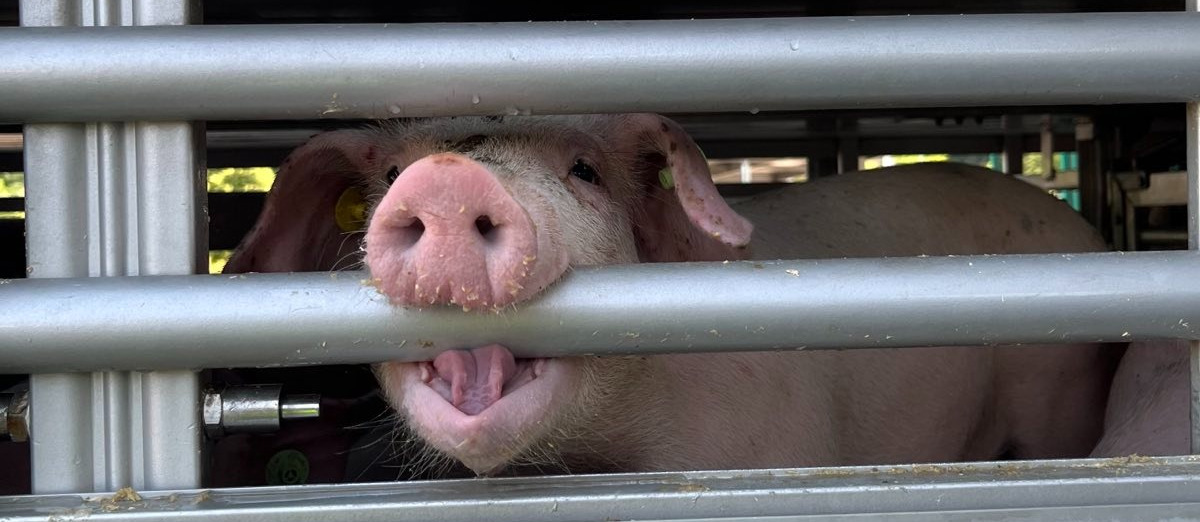
The Greens in the European Parliament, together with European citizens, have been calling for stricter animal welfare laws at the EU-level for years. However, the European People’s Party, and in particular the ÖVP, is working against animal welfare and wants to prevent the introduction of higher standards. A revision of European animal welfare legislation announced by the European Commission was only partially implemented at the end of the last mandate. Negotiations are currently underway in the institutions on the laws on animal transport and on dog and cat breeding. Whether and when further planned laws on animal protection will be published is unclear at present.
Why do we need stricter animal welfare laws?
1. For the animals
Animals are sentient beings, which is also recognized in the EU treaties. We know that animals feel pain and fear and need a minimum level of protection. In many areas of animal husbandry, there are still no uniform EU minimum standards, which sometimes leads to catastrophic conditions for animals in the EU. Be it in the barn, on the street, at the slaughterhouse or in breeding facilities: Animal suffering is a sad reality in Europe.
2. For citizens
Animal welfare is an important issue for European citizens. Of the 10 European Citizens’ Initiatives that have managed to reach over one million signatures, five deal with animal welfare issues. From the ‘Cruelty free cosmetics’ initiative, which campaigns against unnecessary animal testing, to ‘fur free Europe’, which campaigns for an end to fur farms in Europe, to the famous ‘End the cage age’ initiative, which is one of the most successful citizens’ initiatives of all time with 1.4 million signatures and campaigns for an end to cage farming across Europe – they all show that Europeans are passionate about animal welfare.
A Eurobarometer survey from 2023 shows: 84% of European citizens think that the conditions in which farm animals are kept in their respective countries of origin should be better than they currently are, and 83% want shorter transportation times when transporting live animals.
3. For the economy
Some member states, including Austria, already have strict animal welfare laws. Farmers, breeders and transporters in Austria already comply with higher animal welfare standards than competitors from other EU countries, which leads to competitive disadvantages for the domestic economy. European minimum standards would therefore support the domestic economy and agriculture, especially for our Austrian small-scale agriculture, which already implements these standards anyway.
4. For the climate
Protecting animals also means protecting the climate. Intensive livestock farming places an enormous strain on our environment. Unlike pasture-based regional livestock farming, where animals are kept on pasture land and the meat is then sold regionally, intensive globalized factory farming requires an enormous amount of resources. From importing feed for fattening—often soy from Brazil and Argentina, for which huge plantations are built and primeval forests are cut down—to transporting live animals or meat halfway around the globe, to contaminating groundwater with manure, this type of animal husbandry pollutes our planet and hereby also the basis of our agriculture. Regional livestock farming with high animal welfare standards is good for people, animals, and our planet.
Broken reform promises
In 2020, at the beginning of the last legislature, the then new Commission President Ursula von der Leyen presented the “Farm to Fork” strategy as part of the new Green Deal. In it, it was announced that the Commission would revise European animal welfare legislation in order to adapt it to the latest scientific findings. The following laws were meant to be revised or newly introduced by 2023:
- New standards for the husbandry of farm animals
- Revision of the Animal Transport Regulation
- Revision of the Regulation on the protection of animals at slaughter
- Proposal for new legislation on animal welfare labeling
Until summer 2023, the Commission gave assurances that the proposals were in progress as planned and would be published the same year. However, as early as autumn 2023, there was increasing talk about the proposals being stopped at the last minute. Finally, in December 2023, out of the planned laws, the Commission published only the proposal for a Revision of the Animal Transport Regulation. In addition, it surprisingly published a previously unannounced proposal for a new regulation on the welfare of dogs and cats in breeding. According to sources close to the Commission, the drafts of the missing animal welfare laws had already been completed in 2023 but were held back. It can be assumed that Ursula von der Leyen has given in to pressure from her conservative party colleagues, who have long campaigned against higher animal welfare and environmental standards.
The ÖVP’s false claims against climate and animal protection
In recent years, a clear shift to the right could be observed in the European conservative parties. Whereas cooperation was still possible at the beginning of the last mandate, in the run-up to the 2024 EU elections, more and more representatives of the European Conservative Party were opposing their own Commission President and trying to prevent the Green Deal and hereby prevent climate, environmental and animal protection at all levels. Efforts by the industrial lobby were very clearly behind this, to the detriment of European citizens and agriculture. The arguments repeatedly put forward by industry lobbyists and echoed by conservative politicians in this context are very easy to refute:
Negative impact on farmers
Farmers want their animals to be well. Stricter animal welfare regulations, e.g., during transportation or at the time of slaughter, are in the interests of those farmers who have raised and cared for these animals from birth. It is clear that farmers must be financially supported in the transition. In order to implement animal welfare regulations in agriculture, for example by putting an end to fully slatted floors or cage farming, barn conversions will be necessary. Funding for this is already included in the Common Agricultural Policy (CAP), i.e., in EU funds for agriculture.
Food security
The biggest threat to food security is the climate crisis and animal husbandry plays an important role here. Better animal welfare is also good for the climate and therefore makes a significant contribution to food security. Switching to local production with high animal welfare standards also contributes significantly to independence from global supply chains.
Same rules for different conditions
Be it animal transport, breeding or animal husbandry: The argument is always that you cannot lump everything together. This is true, which is why all legislative proposals are always differentiated and species-specific and include exemptions for topographical peculiarities.
Higher prices for consumers
The biggest part of a product’s price is attributable to trade, transportation or logistics. The cost of production only accounts for a small part of the price that consumers pay for food in the supermarket. A small increase in production costs due to higher animal welfare standards will only mean barely noticeable price adjustments for consumers. However, it is clear that farmers must be compensated for the higher costs.
Competitive disadvantages due to unequal standards
Europe’s conservatives like to argue that European producers are at a competitive disadvantage if standards are raised in Europe while competitors outside the EU work with lower standards. This is why the Greens have long been calling for so-called “mirror clauses” in trade agreements with third countries to ensure that European standards are also adhered to in imports. The EPP’s insistence on trade agreements that do not take these standards into account, such as the MERCOSUR trade agreement, certainly does not help European agriculture.
Too much bureaucracy
The EPP, above all the ÖVP, repeatedly speaks of excessive EU bureaucracy, but does not differentiate between European and national legislation. The majority of environmental and climate protection regulations are targets implemented by states. Reducing bureaucracy here could easily be achieved through more efficient information processing on the national level. Situations in which a separate form has to be filled out for each measure are clearly due to national infrastructure. We must also not forget that climate and the environmental protection regulations protect vulnerable parts of society in particular. While large corporations cause the climate crisis, citizens have to pay for the costs of climate adaptation. This must be changed, which can only happen through strong laws that protect citizens.
Fight for better animal welfare
After the Commission’s publication of two of the planned legislative proposals in 2023, at the end of the last mandate, they are currently being negotiated in the European Parliament and by the member states. The EPP is hereby playing a very inglorious role and has been trying for months to delay the negotiations or, where this is not possible, to lower animal protection standards. It will be an uphill struggle to pass legislation on the protection of cats and dogs in breeding and of animals during transportation.
Breeding of dogs and cats
The proposal for a regulation on the welfare of dogs and cats and their traceability aims to improve the hitherto completely unregulated conditions in breeding facilities within the European Union. The sometimes catastrophic conditions under which cats and dogs have to live in European breeding facilities have already been exposed many times by animal welfare organizations. PETA Germany puts it in shocking terms: “Many animals – for example in the illegal trade in puppies and cats – suffer from being kept in cramped cages, lack of exercise and inadequate care. Many animals are raised in basements, do not see daylight and receive inadequate medical care.” To counteract this animal suffering, the EU Commission is proposing basic minimum standards to improve the lives of these animals. The standards should apply to breeding facilities with three or more breeding bitches or cats, not to private households. The proposal includes the following requirements:
- daily access to sunlight for dogs
- minimum space requirements
- species-appropriate provision of food and water
- minimum age for the sale of puppies and kittens
- a ban on the routine docking of tails or ears except for medical reasons
- an official permit for breeders and the inspection of facilities
- mandatory chipping for all dogs and cats to prevent illegal trade
However, even these absolute minimum requirements go too far for the European People’s Party, above all the ÖVP. Alexander Bernhuber, ÖVP, has tabled a rejection amendment to the European Parliament for the entire proposal. According to the ÖVP, the Commission’s proposals for minimum standards for the breeding of dogs and cats should be rejected. In the event that the rejection amendment is not adopted by Parliament, Alexander Bernhuber has tabled further amendments aimed at watering down the text as much as possible. Among other things:
- deprivation of sunlight and exercise should not be defined as animal suffering
- no legal minimum standards for food quantities or space provision
- no ban on food that causes animal suffering
- no ban on keeping cats and dogs in cages
- no temperature requirements
The AGRI Committee adopted its position on the report in May. Following the approval of the draft law in the Plenary, MEPs will now enter into negotiations with the Council on the final shape of the law.
Animal transport
The Commission’s proposal for a regulation on the protection of animals during transport is largely based on the findings of the Committee of Inquiry on Animal Transport (ANIT) initiated by the Greens in the European Parliament, which drafted recommendations for the European Commission. The Commission proposal contains a number of revisions, including:
- 9 hours maximum transport time for animals for slaughter, instead of up to 29 hours as before, depending on age and species,
- 5 weeks minimum transport age for calves, instead of 10 days as before,
- stricter approval regulations for transport vessels,
- space requirements based on the actual body size of the animals, instead of according to species as before.
Unfortunately, there are also major loopholes in the proposal, for example, transportation by ship should still not to counted as transport time, which means that animals can continue to spend weeks and months on animal transport ships. In addition, there should still not be any restrictions on exports to third countries. Nevertheless, even this proposal goes to far for the European People’s Party, who tabled a rejection proposal here, too.
The rapporteur in the European Parliament, Daniel Buda (EPP), has long tried to delay the negotiations. After pressure from the Greens, there is now a fixed timetable. The report must be voted on in plenary by December, following negotiations at committee level, in which Thomas Waitz represented the Greens’ demands as shadow rapporteur.
Outlook
Following the vote on the proposals on cats and dogs in breeding and animal transportation in the European Parliament, the proposals will now progress to trilogue negotiations between the Commission, Parliament and member states. It is not yet possible to say when the laws will be finalized and what their exact content will be. Whether and in what form the remaining legislative proposals on animal husbandry, slaughter and animal welfare labeling will be published is also unclear. Animal Welfare Commissioner Oliver Varhelyi announced in a debate in the European Parliament at the beginning of 2025 that the outstanding proposals would be published in 2026. In terms of content, Commissioner Varhelyi confirmed that the Commission will make a proposal that will address the concerns of the signatories of the “End the cage age” initiative without providing further details. In any case, the Greens in the European Parliament will continue to fight to make Europe a leader in animal welfare.