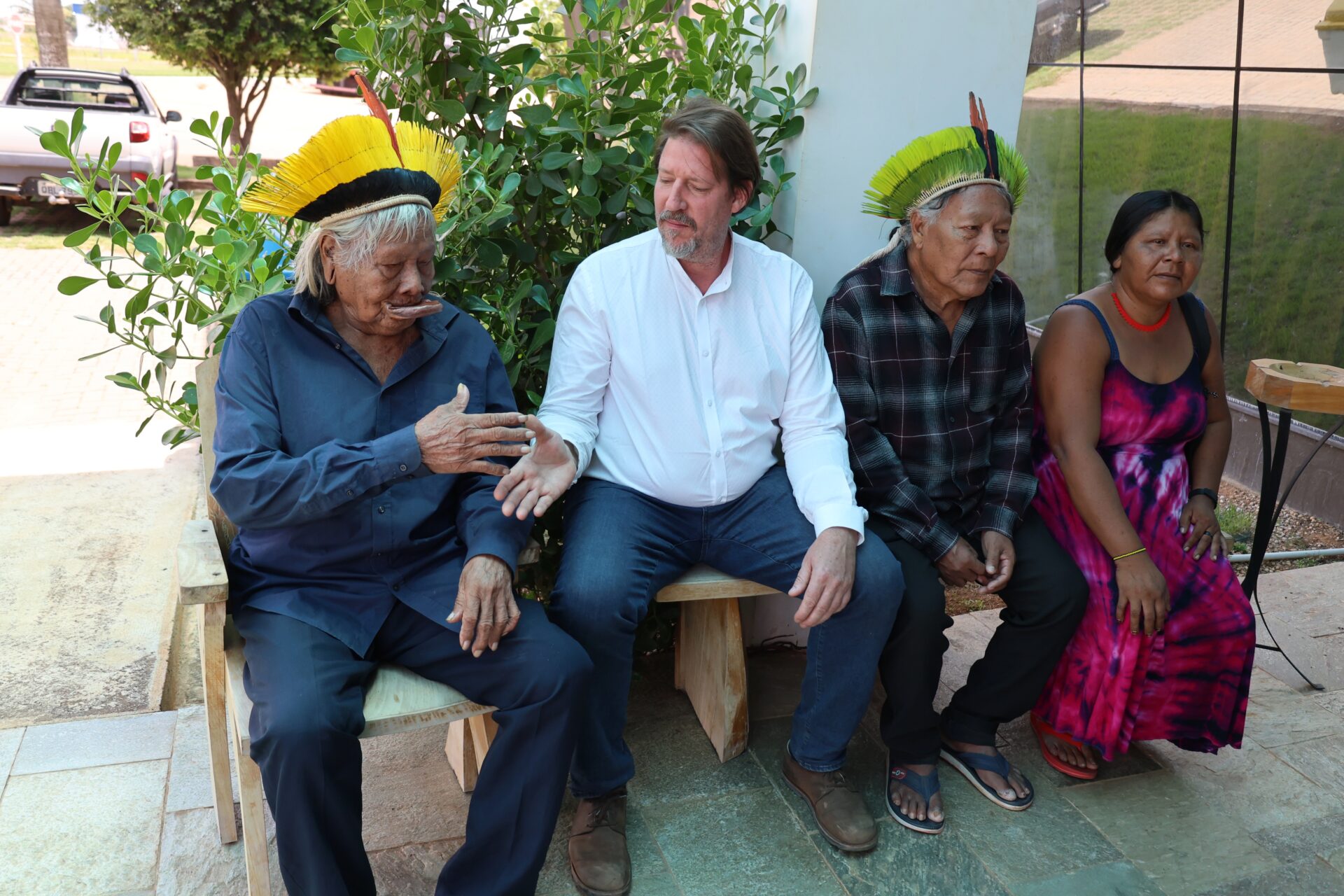
There are encounters that stay with you. My meeting with Chief Raoni, an icon of Indigenous resistance, was certainly one of them.
Chief Raoni, now well over 90 years old, has been fighting for decades to protect the Amazon and to defend Indigenous rights. Since the 1980s, he has engaged in international diplomacy, travelling tirelessly to meet governments, international organisations and political decision-makers. His message has always been clear: the protection of Indigenous territories is a fundamental prerequisite for protecting the rainforest and thus for global climate stability. Respect for Indigenous communities. Respect for the forest.
Peixoto de Azevedo – A Place of Exploitation
We met in Peixoto de Azevedo, in the northern part of the Brazilian state of Mato Grosso. The town is closely linked to the gold rush of the 1980s and 1990s—a period marked by extreme violence, lawlessness and exploitation, not only of the land but also of people.
Indigenous communities were particularly affected: through displacement, environmental destruction, disease, discrimination and direct violence. To this day, Peixoto de Azevedo stands as an example of an economic model that prioritises short-term profit over human rights and ecological responsibility.
Meeting Chief Raoni here— in a city that displays his image on billboards while at the same time pushing Indigenous communities to the margins on a daily basis—gave the conversation a particular weight.
A Clear Presence
When Chief Raoni entered the room, his calm yet determined presence was immediately felt. Shortly before, he had met King Charles III in London, as widely reported internationally—another sign of how far his diplomacy and activism reach.
Our meeting took place in a hotel seminar room. Behind us hung large-scale images of the Amazon: lush rainforest, colourful macaws, idyllic scenes. An almost ironic backdrop when one considers how real and urgent the threat to this ecosystem is—and how much of it has already been irreversibly destroyed.
Learning from One Another and Fighting Together
When Chief Raoni speaks, the entire room falls silent. The presence and intensity with which he conveys his message are unique. He spoke in his Indigenous language; a teacher from the village, Monhire Metuktire, translated into Portuguese, and my trusted interpreter Cristiana Ferraz Coimbra translated into English. Despite the double translation, one thing was clear: this fight for survival is a shared one.
After a brief introduction, I spoke about the impressions I took with me from Metuktire, his village—about the conversations with the Chiefs, the daily life of the community and the remarkable hospitality shown to me. I also reported on my further travels to Brasília and Goiás with the delegation of the European Parliament’s Committee on Agriculture. I explained that we would be meeting numerous Brazilian politicians there, and that I intend to carry forward the experiences, voices and calls from Metuktire.
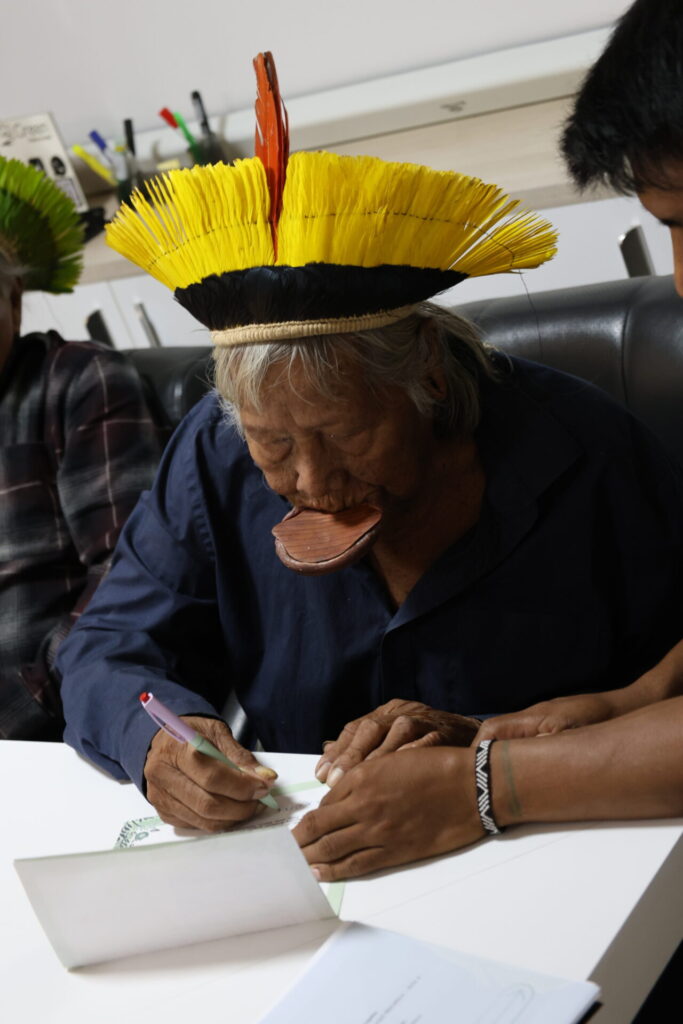
Representatives from Metuktire had entrusted me with a letter, addressed to political decision-makers in both Brussels and Brasília. In this letter, they outline their demands, concerns and expectations of international politics.
With slightly trembling hands, Chief Raoni signed the letter. For me, this was a great honour and, at the same time, a clear mandate. This letter is not an appeal from afar—it is a concrete call for all of us, on both sides of the Atlantic, to take responsibility.
More information, as well as the English translation of the letter, can be found here:
https://thomaswaitz.eu/language/de/kayapo-und-der-kampf-um-den-amazonas-ein-brief-fuer-bruessel-und-brasilia/